This is default featured slide 1 title

Go to Blogger edit html and find these sentences.Now replace these sentences with your own descriptions.

This is default featured slide 2 title

Go to Blogger edit html and find these sentences.Now replace these sentences with your own descriptions.

This is default featured slide 3 title

Go to Blogger edit html and find these sentences.Now replace these sentences with your own descriptions.

This is default featured slide 4 title

Go to Blogger edit html and find these sentences.Now replace these sentences with your own descriptions.

This is default featured slide 5 title

Go to Blogger edit html and find these sentences.Now replace these sentences with your own descriptions.

Showing posts with label Daily news. Show all posts

Sunday, March 18, 2012

Ismail Not Deprived Position Share

The majority of the representatives who attended the monthly meeting of Kedah in Complex Pass Pass Mile 9, yesterday, also expressed concern about the difficulties that may be encountered if the two deputy commissioners Pass, Datuk Ir Phahrolrazi and Dr Zawawi Ismail Salleh, remains in committee.

Woman voice free goverment

the street around the Petaling Jaya. Saangor today.

Wages of peace

Cambodia's Curse: The modern history of a troubled land by Joel Brinkley

Reviewed by Sebastian Strangio

PHNOM PENH - In June 2010, diplomats and donors converged on a conference hall in Cambodia's capital for a meeting with senior government officials. Seated in rows with headphones beaming in live translations, donor representatives listened to key ministers speak about the country's progress on a series of agreed to good governance reforms.

Despite concerns raised about a spate of illegal land grabs, persistent human-rights abuses and legal harassment of government critics - all of which prompted the usual vague assurances from officials that the situation would improve - donors offered development aid totaling an unprecedented US$1.1 billion for fiscal 2010-11.

Aid to Cambodia has increased more or less consistently since the United Nations Transitional Authority's (UNTAC) departure from the country in 1993. A child of the 1991 Paris Peace Accords, UNTAC was designed to bring an end to Cambodia's long civil war, establish a functioning electoral system and eventually usher in economic development.

For any observer of contemporary Cambodia, however, the optimism of the UNTAC era now seems almost quaint. If one accepts political commentator Fareed Zakaria's dictum that a democratic system is better symbolized by the impartial judge than the mass plebiscite (Cambodia, after all, has elections), then one glance at the judicial system - where bribery and political interference are more or less the norm - is all it takes to conclude that the country is not meaningfully democratic.

While the Khmer Rouge era has produced reams of historical accounts and personal memoirs, most books focused on contemporary Cambodia peter out in the late 1990s following the death of the Khmer Rouge insurgency and the end of the country's bloody civil war. How Cambodia has since dealt with the wages of peace remains largely unexamined.

It is therefore welcome that American journalist Joel Brinkley chose Cambodia as the subject for his fifth book, Cambodia's Curse: the modern history of a troubled land. Brinkley, a 25-year veteran of the New York Times who shared a Pulitzer Prize for his reporting on the refugee crisis that followed the fall of the Khmer Rouge regime in 1979, returned to Cambodia in 2008 to examine what it had done with UNTAC's $3 billion "gift". What he finds is a country bereft of the rule of law and plagued by grinding poverty, where human development indices are among the lowest in Asia.

Brinkley does a commendable job in sketching out the contours of Cambodian society. His narrative is enlivened by the voices of individual Cambodians who have been marginalized by the country's corrupt political system. Traveling around the country, he examines Cambodia's courts, schools and health system, all of which have been bled dry by graft and hollowed out by years of official neglect.

He visits ramshackle settlements on the edges of Phnom Penh, where thousands of residents have been dumped after being illegally uprooted from valuable land in the city center, and highlights the nexus of corrupt officials and businessmen who have plundered Cambodia's natural resources for personal gain. In one of the book's more memorable passages, Brinkley interviews tycoon and senator Mong Reththy at his luxurious Phnom Penh villa, listening to the businessman proffer a series of thin excuses about the origins of his lavish wealth.

Unfortunately, the book's text is marred by a series of small factual errors. Officials or political parties are occasionally misidentified (Deputy Prime Minister Sok An is not a member of the government's ruling triumvirate, whose three-headed insignia Brinkley spots on the wristwatch of a government official); the now daily Phnom Penh Post was never published weekly, though it was previously a fortnightly publication.

Brinkley also errs when he describes Pol Pot as having died a "free man" in 1998. In fact, the Khmer Rouge leader was living under house arrest at the time of his death after facing a kangaroo court set up by the last remaining members of his Maoist movement. His preface ends with the puzzling assertion that Cambodians "remain the most abused people in the world", a phrase that invites rather aimless comparison with other unfortunate nations in the developing world.

The book's best passages deal with the complex relationship between Cambodia and its Western aid donors. The author deftly charts the process by which government officials, through a combination of flattery and feigned outrage, have learnt to manipulate foreign governments into pledging ever-higher amounts of development assistance, all the while presiding over a system that has consigned the majority of Cambodians to poverty. He also pours acid on those foreign aid workers who, attached to the country's comfortable expatriate lifestyle - Phnom Penh's parallel economy of "espresso bars and stylish restaurants" - see little incentive to rock the boat.

The text falters, however, when Brinkley attempts to answer the questions posed by his own narrative: why, in the final analysis, do contemporary Cambodians seem unable to struggle against those who exploit them? Why do so many seemingly accept poverty and exploitation as their natural lot in life? His thesis, built into the title of his book, is that Cambodia is somehow "cursed" by cultural hand-me-downs from its feudal past. "Far more than almost any other state," he writes, "modern Cambodia is a product of customs and practices set in stone a millennium ago".

"Given their history, given the subservient state Cambodians have accepted without complaint for more than a millennium, they don't seem to care," he adds. "Now, once again, most expect nothing more than they have. They carry no ambitions. They hold no dreams. All they want is to be left alone."

This is hardly the case. The country's modern history is rife with examples of rebellion, of which the Khmer Rouge, while representing its bloody apotheosis, was far from the only significant manifestation. Brinkley's assertion also fails to account for the villagers who have fought back against land grabbing by corrupt officials and the continuing efforts of those human-rights activists, trade union leaders and opposition figures who have stood up to demand more official accountability, often at threat to their lives.

For Brinkley, Cambodia's great hope lies in its foreign donors. If only such governments and international institutions put pressure on prime minister Hun Sen's government to enact key reforms and respect international human-rights law, he reasons, Cambodians might "after 1,000 years" be delivered from their perpetual suffering.

Given Brinkley's emphasis on foreign countries - some of his main sources, tellingly, are former US ambassadors to Cambodia - it is surprising that the rise of China rates only a brief mention in the book's epilogue. In recent years, Beijing has risen to become Cambodia's main source of investment and economic aid, a development that has undoubtedly complicated the West's ability to take a principled policy stand. The related point is that Western donors may actually have wider strategic objectives than promoting human rights or good governance.

By appealing to cultural essentialism and putting much of the onus for change on Cambodia's foreign donors, Brinkley leaves little scope for the possibility that Cambodians themselves may be able to forge their own path to a better life. As the yearly government-donor meetings play out year after year with much the same effect, there may, at the end of the day, be little in the way of an alternative.

China Leads in Assistance to Cambodia

2012-03-17
Xinhua

China is the largest donor in infrastructure development assistance to Cambodia, Cambodian Deputy Prime Minister and Finance Minister Keat Chhon said Saturday.

"China is the No. 1 donor for infrastructure development here, and Japan comes at the second," he told reporters after opening a regional economic forum.

He said that China's aid on infrastructure is vital for Cambodia to boost its long-term economic growth.


According to the Finance Ministry, since 1992, China has provided a total of 2.1 billion U.S. dollars to Cambodia, mainly for the construction of roads, bridges, and irrigation system.

Of the amount, 125 million U.S. dollars is grant, 152 million U. S. dollars is non-interest loan, and the rest is concessional loan.

Cambodian New Year Festival 2012 - San Jose, California


The Cambodian-American community of Santa Clara County will celebrate its
27th Annual Cultural New Year,
Year of the Dragon,
on
Saturday, April 14th, 2012 (3pm to midnight)
at the
Unify Event Center
765 Story Road, San Jose, CA 95122
(Behind Walmart)


We will be sponsoring this event for a fun evening of excitement. The celebration of "Khmer New Year" is a symbol to remind us of our culture and heritage. The Cambodian New Year Festival showcases the richness of Cambodian life in our community. The treasured folk culture and history of Cambodia delight the senses in colorful display of art, music, and dance.

This year, Cambodian New Year Festival 2012 Committee lead by Miss Davy Chea and, will bring us two parts of events. Part-I will feature Khmer Classical Dance & Folk Dances and Traditional Games. Part-II, the social dance, will feature Angkorwat Band and Ms Pinaly.

Human trafficking rackets thrive [in Thailand]

Chawalit: Abuse is increasing

Foreign workers are still being targetted

19/03/2012
Wassayos Ngamkham
Bangkok Post
The cruelty inflicted on them can be extreme. Pol Maj Gen Chawalit recalls a recent rescue of a Cambodian boy in Pattaya who had lost his tongue, after traffickers cut it out to ensure he could not identify the gang.
Human trafficking rackets thriving on deception, fraud and brutality target largely foreign nationals from neighbouring countries and are responsible for placing Thailand on a US watch list, police say.

The Anti-Human Trafficking Division has found the human trafficking rackets smuggle people and supply them as slave or forced labour to the flesh trade, fishing industry, and gangs of street beggars.

Pol Maj Gen Chawalit Sawaengpuet, the division commander, said the traffickers use various methods for luring their targets.

Most common are the rackets which con young girls, most of whom are from Laos, to work as prostitutes.


He said the traffickers pose as brokers to meet the girls, mostly from poor families, in Laos. They promise them jobs as domestic helpers or shop assistants in Thailand.

Pol Maj Gen Chawalit said the rackets give the girls forged passports which make them out to be older than their real age, for easier border clearance.

Soon after they enter Thailand, the girls are taken by another group of traffickers to bars where they are locked up and made to work as prostitutes.

The bars often double as karaoke parlours. They are scattered across the country, from Nong Khai and Udon Thani in the Northeast, to Hat Yai in the South and also Bangkok.

The commander said procuring and trafficking the girls is not a complicated process as the victims arrive in Thailand overland.

In the fishery industry, a similar trafficking ruse is employed to recruit targets _ young Thai men.

At the end of the rice harvesting season, they migrate from the Northeast looking for jobs in the city.

Pol Maj Gen Chawalit said the traffickers seek out the men at the bus terminal at Mor Chit or at interchanges in Sanam Luang or the Victory Monument.

The traffickers befriend the men who are persuaded into joining them for a drink at a karaoke bar.

The bar owner, who is working in collusion with the gang, overcharges the men. Unable to pay the bills, the men are threatened with legal action and most eventually agree to work in the fishery business to pay off their debts.

Pol Maj Gen Chawalit said once aboard the fishing trawlers, the men endure harsh living conditions and mistreatment at the hands of the captain and crew.

In other labour-intensive jobs which hire alien migrant workers, the working conditions are no less cruel.

The commander said the workers, particularly those employed illegally, have no choice but to accept unfair terms of employment.

"It's one form of exploitation after another," he said.

In some cases, women and children from Cambodia are housed together in squalid environments in secret locations. Some are tortured physically for so long they became permanently disabled.

The cruelty inflicted on them can be extreme. Pol Maj Gen Chawalit recalls a recent rescue of a Cambodian boy in Pattaya who had lost his tongue, after traffickers cut it out to ensure he could not identify the gang.

"Sadly, the boy couldn't give us much information," he said.

The disabled victims were forced to beg at intersections and the gang would take all their money.

A 13-year-old Cambodian was forced to work as a garland seller at a busy intersection in Bangkok. Pregnant from rape, she was told by the gang to sell the garlands in the scorching summer heat for many hours almost every day.

Trafficking of humans and drugs often go together. The gangs hook victims on the substance and make them work for it.

Thailand is seen as a key origin, transit point and destination of the gangs.

Last year's annual report on the human trafficking situation in Thailand prepared by the US embassy places Thailand on the Tier 2 watchlist of countries.

Thailand is among 41 countries in Tier 2, Pol Maj Gen Chawalit said.

Thaksin meets with Hun Sen [-So Hun Xen is defending a Thai fugitive?]


18/03/2012
Bangkok Post

Fugitive former premier Thaksin Shinawatra visited Cambodia on Thursday to meet Prime Minister Hun Sen on a personal matter and left the country the next day, a Cambodian news agency said on Friday.

Thaksin visited the kingdom to ask about the health of Hun Sen’s 90-year-old father who is sick.

He left Cambodia on Friday morning, Cambodian Express News (CEN) quoted Cambodia’s government spokesman Phay Siphan as saying.

Mr Phay declined to say if business matters were discussed during the meeting and insisted Thaksin’s trip was personal. He said the former Thai premier only came to meet Hun Sen to inquire about his father’s health, according to CEN.


A Pheu Thai Party source also said on Thursday Thaksin had arrived in Cambodia to visit the sick father of Prime Minister Hun Sen,

Many members of the Pheu Thai Party flew to Cambodia to meet Thaksin, the source added.

Thaksin was spotted by reporters at Phokeethra Golf and Spa Resort in Siem Reap. He was accompanied by former Thai Rak Thai executive Yongyuth Tiyapairat, red shirt leader Suporn Attawong and National Parks, Wildlife and Plant Conservation Department chief Damrong Pidech.

Noppadon Pattama, Thaksin's legal adviser, said it was normal for Pheu Thai members to go and see Thaksin when he arrives in a neighbouring country for a visit. Mr Noppadon insisted Thaksin's stay in Cambodia had no political motive. Now is not the time for any major reshuffle of the cabinet or government officials, he said.

NGO gives poor Cambodians hope

FRIENDS:The Formosa Budding Hope Association is helping poor Cambodians, many of whom have never seen a doctor, and raising Taiwan’s international profile

Mon, Mar 19, 2012
Staff Writer, with CNA

A Taiwanese humanitarian aid group said that while Taiwan may have few diplomatic allies, it is regarded by many Cambodian villagers as their best friend.

“Even if we’re suppressed in the international arena, it doesn’t mean we should not extend a friendly hand or share our expertise, especially in the field of medicine,” said Sally Yu (余慈薰), director of the Formosa Budding Hope Association’s Cambodian branch. “It’s what many people need and what Taiwan can provide.”

The non-governmental organization (NGO) she helped found offers medical and educational aid to thousands of people in Cambodia.


It was established in December 2010 by Yu and Hsu Yu-pi (許毓丕), a dentist who has been providing free dental services in Cambodia since 2006.

In a gesture of long-term commitment, Budding Hope opened a branch in Cambodia on March 9. It is one of the few Taiwanese NGOs to register in Cambodia, which does not have diplomatic ties with Taiwan.

Since the NGO’s establishment, it has carried out 10 medical missions in 25 remote villages in Siem Reap Province in northern Cambodia, offering free medical services to about 15,000 people.

“Many of the villagers we serve have never seen a doctor before,” Yu said.

The local health centers in such areas are often staffed only by nurses who help deliver babies and provide painkillers, she said.

“We [Taiwan] can do much more because we have a quality, high-tech medical industry,” Yu added.

In 2010, Budding Hope obtained help from the Taiwanese government to treat a two-year-old Cambodian girl who had a massively swollen right arm.

The girl had surgery in Taiwan to successfully reduce the swelling, which had made her right arm five times the size of her left.

On each Budding Hope medical mission to Cambodia, about 100 doctors and volunteers provide mainly dental services and sometimes treatment for skin, eye and stomach problems, Yu said. Aside from working with two Cambodian orphanages to provide the children there with food and school necessities, the association also gives financial assistance to about 200 Cambodian children and their families, offering food, clothes, shoes and school supplies.

However, the work of the association is not just about giving funds, but also finding ways to help people pull themselves out of poverty, she said.

To this end, the association is planning to launch a program in May that will teach Cambodian women how to grow mushrooms on wood chips in plastic bags, and how to market the crop.

Noting that in Cambodia, the wet and dry seasons are long, which makes it hard for people to grow crops, Yu said the wood chips and bags, imported from Taiwan, could help to overcome that problem.

“Taiwan has the technology, and we hope to use Taiwan’s experience to help Cambodian women in rural villages increase their household incomes by trying out different farming methods,” she said.

With such work, the association also hopes to lift Taiwan’s profile in the international community.

“We hope to show local and international organizations, such as the UN, that Taiwan is here as well,” Yu said.

Cambodia-Asia Economic Forum kicks off

PHNOM PENH: The 8th Asia Economic Forum kicked off here on Saturday, focusing on reviewing the ASEAN achievements in the past 45 years and looking at opportunities and challenges toward the realization of an ASEAN community by 2015.

The 2-day forum has been attending by some 300 economists, academics, researchers, and policy makers from Asian countries, Xinhua reported.

Haruhisa Handa, advisor to Cambodian Prime Minister Hun Sen and chairman of Asia Economic Forum, said the forum, under the theme " ASEAN in the Evolving Regional Architecture: Opportunities, Challenges and Future Direction", aimed at examining how ASEAN has been able to develop and transform itself in the past 45 years of its existence.


It would also look at ways to enhance ASEAN centrality in the evolving regional architecture and identify ASEAN’s future priorities and challenges toward the realization of an ASEAN community by 2015, he said.

Moreover, the forum would deliberate on how ASEAN can strategically best engage its dialogue partners in the coming years, and at the same time to play a positive role in its relations with the major powers in the region.

Speaking at the opening of the forum, Cambodian Deputy Prime Minister Keat Chhon, Minister of Economy and Finance, said the ASEAN has made tremendous progress in all areas of cooperation in the last forty-five years, but challenges are still ahead toward a community.

"Since its inception in 1967, the ASEAN has not only accelerated the pace of diplomatic prominence, the rise of its profile internationally, but has also had a great impact on major power relations in the region and the wider world," he said. "The bloc has achieved many goals, but with those successes, it does not mean there are no challenges."

He said ASEAN needed to strengthen its participatory capacity in global solution cooperation reflecting the contribution of ASEAN to global affairs, in which prestige and role of ASEAN will be further enhanced at international arena.

Those global affairs include economic crisis, climate change, natural disaster management, prevention and combat of contagious disease as well as fighting against crime and cross border terrorism, he said.

In addition, the minister said, ASEAN has to speed up the process of dividing development gap among ASEAN member countries, which is prerequisite requirement to ensure regional competitiveness and rationalization of regional integration and implementation of action plan of ASEAN integration initiatives.

"ASEAN is an important player in the region among other successful organizations in the world. I strongly believe that ASEAN community will be realized in next two years," he said.

The forum was founded in 2004 by a Japanese Haruhisa Handa, advisor to Cambodian Prime Minister Hun Sen and president of International Foundation for Arts and Culture,and has been held every year in Cambodia, organized by the University of Cambodia and sponsored by the International Foundation for Arts and Culture.

The Association of Southeast Asian Nations (ASEAN) groups Brunei, Cambodia, Indonesia, Laos, Malaysia, Myanmar, the Philippines, Singapore, Thailand and Vietnam.

Activists pull out of meeting with Asean leaders

18/03/2012
Achara Ashayagachat
Bangkok Post

Independent Asean activists will boycott a traditional meeting with regional leaders in a sideline session of the Asean Summit in Phnom Penh next month after the Cambodian government set conditions for nominating their representatives.

Asean non-profit organisation representatives were to meet Asean leaders on April 3 in a related session of the summit in Phnom Penh on April 3-4 under the so-called interface dialogue.

Phnom Penh has sidestepped the nomination of representatives by telling its Asean colleagues to nominate their own people instead of the Asean Civil Society Conference and the Asean People's Forum (ACSC/APF) as normal.

NGOs said Cambodia's action has undermined the process of independent groups galvanising local support and coordinating functions with other Asean counterparts.


Suntaree Saeng-ging, secretary-general of the Thai NGO Coordination Committee, told the Bangkok Post the Asean NGOs have decided to proceed with their own plans with an ACSC/APF meeting at the Lucky Star Hotel in Phnom Penh on March 29. The theme of transforming Asean into a people-centred community will have as its keynote speaker a renowned political prisoner from Myanmar, Min Ko Naing. But they will boycott the government interface.

"Why do we have to be their decoration and simply let ourselves be used as a justification that Asean is participatory and people-centred, despite their negligence towards the significance of transparency and accountability for the people's voices," Ms Suntaree said.

An activist source said the Cambodian Council of Ministers was responsible for the nomination issue, not the Foreign Ministry.

The Council of Ministers has assigned two Cambodian representatives - a woman, Prak Sokhany, executive director of Cambodian Civil Society Partnership, and a youth - to meet at the interface dialogue on April 3.

Phnom Penh also told its Asean partners to select two people from their respective NGOs. In Thailand's case, the Social Development and Human Security Ministry has nominated Chalida Tacharoensak from the People's Empowerment Foundation, sources said.

This has undermined the fragile unity and poor coordination among NGOs in all Asean countries, another source said.

Cambodia Embracing Capitalism With First IPO Since Khmer Rouge

Mar 18, 2012
By Joyce Koh
Bloomberg

Min Sovannry wasn’t born when the Communist Khmer Rouge took power in 1975 and abolished Cambodia’s money, markets and financial system. Now the 21-year- old college student can’t wait to embrace capitalism.

One of thousands of Cambodians who have attended more than 200 stock-trading seminars in Phnom Penh, Min said she plans to invest as much as one-third of the $300 monthly salary she expects to earn next year in the country’s stock exchange, which is scheduled to begin trading its first shares April 18.

“I’m very excited,” Min said in an interview. “I’m happy to have this market because it’s a chance for me to make money from buying stocks instead of putting it in the bank.”

Enthusiasm about the start of trading at the exchange, which opened last July without a single listed company, extends beyond the borders of the Southeast Asian country. Investors including Templeton Emerging Markets Group Chairman Mark Mobius said they plan to participate in Cambodia’s stock market after state-owned Phnom Penh Water Supply Authority has its initial public offering next month.


“The potential for investors in Cambodia is excellent,” Mobius, who oversees about $50 billion, wrote in an e-mail. “The listing of publicly traded stocks will drive up interest and demand. If a country can list its state-owned enterprises and list enough stocks so that foreign investors can get involved, then it can be very, very good.”

Phnom Penh Roadshow

Demand for Phnom Penh Water’s shares is more than 10 times the amount available, according to a person with knowledge of the matter who declined to be named because he wasn’t authorized to speak about the IPO. The company, which plans to raise as much as 82.8 billion riel ($20.7 million), held a two-week roadshow in the nation’s capital starting Feb. 29 with about 400 potential investors crammed into a conference hall with seating capacity for half that number.

Two more state-owned companies are expected to list in the coming year: Telecom Cambodia and Sihanoukville Autonomous Port.

With two dozen computers in an air-conditioned room on the 25th floor of Phnom Penh’s tallest office building, Cambodia Securities Exchange Co. is a joint venture with Korea Exchange Inc. (KOSPI), the operator of the Seoul bourse.

“I have met more than 100 foreign investors who came to Cambodia because of the stock exchange,” said Han Kyung Tae, managing director of Tong Yang Securities (Cambodia) Plc, which is managing the Phnom Penh Water IPO. “They are very serious. They see the potential, and they’re very, very positive about Cambodia’s economy.”

Spurring Development

Economic growth in Cambodia, sandwiched between Thailand, Vietnam and Laos with a population of 14.3 million, may reach 6.5 percent this year, according to the Asian Development Bank. That’s less than the average of 8 percent it experienced from 2001 to 2010 and compares with the development bank’s estimate of 8.8 percent expansion for China and 6.3 percent for Vietnam.

The Cambodian government has said it wants to spur economic development by privatizing its state-owned companies and encouraging private enterprises to expand with new funding. The three share offerings, with the possibility of two more after that, are expected to encourage private companies to list.

Within five years, the market value of traded shares could constitute a quarter of the country’s gross domestic product, or more than $3 billion, said Kao Thach, 39, deputy director general of the Securities and Exchange Commission of Cambodia. Banks, telecommunications companies, rice millers, garment firms and mining companies could seek public listings, he said in a February interview in Phnom Penh.

“If we have a complete financial system, the economy can grow very fast and be stable,” he said. “Small or big, at least we have a complete financial system.”

Abolishing Money

That system was fractured in 1975 when the Khmer Rouge captured Phnom Penh during the final stages of the Vietnam War. Its Communist guerrillas blew up the central bank, declared currency worthless and outlawed private property and trading.

During leader Pol Pot’s reign, Cambodia’s fertile countryside became the killing fields where 1.7 million people, or 20 percent of the population, perished. The currency, the riel, was reintroduced in 1980 following a Vietnamese invasion to rout the Khmer Rouge.

Almost four decades after Pol Pot exterminated the country’s educated classes and emptied its cities, distrust of the currency and financial system has remained high among Cambodians, who have one of the lowest savings rates in Asia.

Savings Rate

As a percentage of economic output, Cambodia’s savings rate was 14.4 percent in 2010 compared with 27 percent in neighboring Vietnam and 53 percent in China, according to the Asian Development Bank. The U.S. dollar is still widely used, though the government is trying to encourage acceptance of the riel. Shares of PPWSA and the other companies will trade in riel.

The bourse itself has been delayed several times since 2009, derailed by the global financial crisis, technical issues and lack of readiness among Cambodia’s companies.

“I feel like I’m constructing a highway with a couple of shovels, with no experienced co-workers,” said Han of Tong Yang Securities about the difficulties of managing the country’s first IPO. “But we tell each other, we are a part of the history of capital markets. We encourage one another like that. Otherwise it will be very, very frustrating.”

Administrative ‘Hoops’

Tokyo-based Asset Design Co. and Frontaura Capital LLC of Chicago said that while they’re interested in investing in Cambodia there are hurdles. A high valuation for the PPWSA offering and administrative hassles like having to turn up in person to transfer money are among the drawbacks, said Nick Padgett, managing director of Frontaura, which invests more than $90 million in countries such as Tanzania, Serbia and Pakistan.

“Everyone is enthusiastic and eager, but this is a first- time experience for the country and its institutions, and they have a lot of learning to do,” Padgett said. “There are a lot of hoops to jump through for foreign investors and at the end of the day, some investors will decide it is not worth it.”

The SECC plans to hire 10 to 15 people a year to add to the more than 80 currently employed, Kao said. The regulator, established four years ago, has already approved seven securities underwriters.

“When it’s crowded with companies queuing for IPOs, you will see that this number is not enough,” said Kao. His goal is for the regulator to implement adequate enforcement and education. “Market confidence will be very crucial. If it fails one time, we’ll need at least 20 years to restore the confidence. We cannot afford it.”

Stock Seminars

More than 5,000 Cambodians attended 200 trading seminars organized by Phnom Penh Securities since June, said Chief Executive Officer Stephen Hsu, a Taiwanese who moved to Cambodia and has hired 45 brokers, underwriters, auditors, advisers and managers. He plans to add 50 staff by the end of the year and set up brokerage branches in Phnom Penh and Siem Reap, close to the 12th century Angkor Wat temple complex.

“Almost all the clients do not know how to trade and what a stock is,” said Hsu, who moved to Phnom Penh two years ago. “The human character is to make money, and the stock market is one of the key methods.”

Ly Bora, 27, a broker for Phnom Penh Securities who has taught more than 30 of the seminars, including one at a local business college attended by Min Sovannry, said that government officials, foreign investors and local businessmen as well as students were among the attendees. His biggest presentation was to an audience of 300 in one of the capital’s hotels.

“This is the new era for Cambodia,” said Ly, whose parents kept their savings under the mattress and in cupboards. “Cambodians did not trust the financial system before. They put their money at home. Now they have options and can put it in the bank or invest.”

‘On the Move’

Ly said he has signed almost 300 customers since he started working at the company last April and wants to open 1,000 accounts in three years.

At Acleda Securities, a unit of the country’s biggest bank with more than $1 billion in deposits, managing director Svay Hay said he expects 5 percent of its 700,000 depositors to be potential investors in the stock market. The company’s new six- story building in Phnom Penh will attract more clients and contribute to the nascent sector, Hay said.

“This is a country on the move,” said Bretton Sciaroni, chairman of the American Cambodian Business Council, whose Phnom Penh law firm, Sciaroni & Associates, advises on investments. “They come from a very tragic history, but what they’ve seen in the last 20 years is all kinds of progress going on.”

Booms, Busts, Boredom

Investor interest in Cambodia’s new capital market may cool after the initial euphoria, as evidenced by the experiences of exchanges in neighboring Vietnam and Laos.

“A new emerging-markets stock exchange takes a decade to mature at best, with booms, busts and boredom along the way,” said Douglas Clayton, founder and CEO of Phnom Penh-based Leopard Capital, whose $34 million Leopard Cambodia Fund invests in closely held companies. “The Cambodia stock exchange will explore all of these phases at different times, but even so will help mobilize capital for private-sector development.”

Vietnam’s stock exchange, started in 2000, now lists more than 300 companies with a market value of about 500 trillion dong ($24 billion). The Ho Chi Minh Index surged four-fold from 2006 to 2008 to touch a high of more than 1,100 before tumbling during the 2008 financial crisis. It now trades at about 430.

Laos, Southeast Asia’s smallest economy, opened its stock exchange in January 2011. The two-stock Composite Index soared 86 percent in the first three weeks of operation. It has since fallen 50 percent.

Lack of Trust

At the Cambodian exchange, a glass pane looking into the empty room is printed with a graph of the stock-market index shooting to 15,000 over the next 10 years.

“My parents say they don’t trust this market,” said Min, who is studying business and finance. “Sometimes I try to explain, but they still don’t understand. I trust this because our government is trying so hard to push this trend.”

Investors in Cambodia’s market face risks because of ineffective financial and legal systems, Sam Rainsy, 62, a former fund manager with Banque Paribas and onetime Cambodian finance minister, said in a February interview in Paris. Cambodia was ranked by Transparency International last year as 164th in the world by perception of corruption, ahead of only North Korea, Myanmar and Afghanistan in Asia.

Fleeing Cambodia

Hong Sok Hour, 37, head of the stock exchange, said his two biggest challenges are to build public confidence in the bourse and to ensure listed companies comply with all the requirements of transparency and corporate governance.

“If I speak purely as the CEO of a stock exchange, I will say I’ll try to develop the market as fast as possible,” he said. “But as a civil servant of the government, I need to take into account government priorities. I need to make sure that everything will operate smoothly.”

At one of the stock-trading seminars in Phnom Penh, Paul Quach was taking notes and mulling whether to seek a public listing for his seven-year-old company, which operates seven school campuses in the capital. Quach, chief financial officer and vice chairman of the firm, Mengly J. Quach Group, majority- owned by his brother, ran through Cambodia’s jungles to Thailand when he was 17 to flee the turmoil in his country. Now 48 and a U.S. citizen, he returned to Cambodia five months ago to help build the company.

“After I understand more, we can think about an IPO,” said Quach, who added that he is amazed that the ravages of war have been replaced by progress and that the country is drawing people from all parts of the world.

“Cambodia is growing very rapidly, very fast,” said Quach. “The same jungle where I escaped from has become a casino, a playground where tourists go.”

Cambodia's first IPO nears

19/03/2012
Anthony Galliano
Bangkok Post

Cambodia's first initial public offering is fast approaching, and demand is expected to be robust.

Bookbuilding, the process during which bids are taken and a price set for shares, ended last Wednesday for Phnom Penh Water Supply Authority (PPWSA). The final offering price will be announced before subscriptions begin on March 29, with the listing date set for April 18.

PPWSA intends to issue 13.04 million ordinary shares with a par value of 1,000 riels (7.70 baht or 25 US cents) each. This represents a 15% float. Eleven percent of the float will be allocated to the company's employee stock option plan.

The state, represented by the Ministry of Economy and Finance, will retain 85% ownership or 73.9 million shares.


The shares will be available to both Cambodian citizens (a 20% allotment) and non-Cambodians. Permitting foreign investor participation should dramatically improve the prospects for the IPO as this will be the only publicly traded equity exposure in Cambodia.

TongYang Securities (Cambodia) Plc, an affiliate of South Korea's TongYang Securities Inc, is the sole underwriter, bookrunner and lead manager.

The indicative offering price for PPWSA has been set in a very wide range from US$1.00 to $1.57 a share.

With a maximum of 10.4 million shares available to foreign investors, at the highest end of the offering price range, it would take only US$16.5 million to fully subscribe to the maximum foreign allotment. There is no mention of a greenshoe option, a provision allowing the underwriter to sell more shares if demand warrants.

PPWSA has a lot going for it. The company is the monopoly water supplier covering Phnom Penh's eight districts as well as Takmao town to the north.

Licences to new suppliers are granted by the government in areas where there is no existing water supplier.

Despite being a state-owned monopoly, PPWSA has emerged as an internationally recognised leader in its industry. Its trophy case includes the Water for All award from the Asian Development Bank in 2004, and the Stockholm Industry Award Water Award in 2010.

The jury for the latter award noted that PPWSA was self-sufficient company, operating without subsidies from the state, providing 24-hour service and 90% coverage to a city of 1.3 million, and fully recovering its costs as it continues to develop both its infrastructure and management.

The company's revenues were were $26 million in 2010, up 10.4% from 2009, and were estimated to have increased by 8.7% in 2011. Net income for 2010 was $7.5 million, a 13.2% increase from 2009. Net income will likely be flat in 2011. Earnings before interest, taxes, depreciation and amortisation increased 9% in 2010, and is estimated to have increased 3% in 2011.

From 2005-10, the company's production capacity increased by 28%.

The proceeds of the offering will be used to reduce debt and fund expansion to improve future revenue growth and earnings. The price-to-earnings ratio is considered reasonable at 11.5 to 18 times, in line with other water utilities around the world. However, the offering price is likely to be four to 5.9 times net asset per share, which is quite expensive. The company is expected to pay a dividend, providing a cash flow to investors.

It is not unusual for an underwriter to price an IPO in such a way that it is well positioned for a successful opening day, which makes investors happy, and creates a buzz in the media as well.

Yelp, the online consumer review site, recently debuted on the New York Stock Exchange with a targeted range of $12-14, opened at $15, and traded up 64% its first day.

From Sideshow To Genocide: Stories of the Cambodian Holocaust” [excerpts]


By Andy Carvin


“I had to help the North Vietnamese, and I have got their promise to respect always Cambodia as an independent state, a neutral state, non-aligned state without any interference in our internal affairs from Vietnam.”

N. Sihanouk
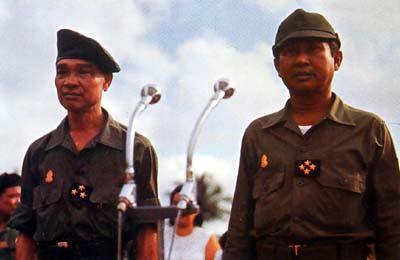
Leaders of the "bloodless coup" of 18 March 1970 Prince Sisowat Sirik Matak [left] and Gen Lon Nol
President R Nixon explained US operations in Cambodia [google image]
Nixon observed of Sihanouk: "He seemed prouder of his musical talents than of his political leadership, and he appeared to me to be totally unrealistic about the problems his country faced" [sic!]
The Illegal Bombing of Cambodia

From the 9th to the 13th centuries, the Cambodian empire of Angkor was the most powerful political force in Southeast Asia. Their expertise in irrigation and public works allowed the Khmer people to build their 250-square-mile capital of Angkor, while their military prowess expanded their control into modern-day Vietnam, Laos and Thailand. Beginning in the fifteenth century, though, the Thai kingdom of Siam began its ascendance in the region. After several half-successful attempts, the Siamese sacked Angkor in 1594. The once great city of Angkor never recovered, and the Khmer empire soon fell to pieces.

By the early 1800s, much of modern Cambodia's territory was either a part of Siam or was a vassal state paying tribute to the Siamese court. Additionally, significant portions of its land were occupied by Vietnamese who were migrating west at a steady rate. Not unlike Siam, Vietnam was Cambodia's historical enemy, but Vietnamese expansion into Cambodian territory proved to be the more humiliating experience. Cambodia managed to maintain its monarchy, but the Khmer kings of this period were largely powerless.


When the French arrived in Southeast Asia to colonize Cochin China (southern Vietnam), it was only a matter of time before they set their eyes on Cambodian territory. The French recognized an excellent opportunity in Cambodia - Cambodia was weak and subservient to the Siamese empire, which was weakening in its own right. But Siam also had the support of Great Britain, France's chief colonial rival. Cambodia could serve as an excellent buffer zone between their precious Cochin China and pro-British Siam. Similarly, King Norodom of Cambodia recognized the French could provide his fragile government protection from Vietnamese encroachment from the east, so in 1863 he signed a treaty of protection. A year later the French annexed Cambodia, adding it to its Indochina union.


For over 75 years the French administered the economic affairs of the Cambodian state. The Cambodian monarchy managed to survive, but as during the Siamese vassal period, the king served largely as a cultural symbol rather than a political leader. Despite occasional unrest, the French colonial period was a relatively quiet time for Cambodia, for France's main interests lay in Vietnam. The Cambodians themselves, though, did not always feel the positive effects of France's hands-off approach since the colonialists employed Vietnamese civil servants to manage Cambodian affairs. Many Cambodians were severely frustrated by the fact that their historical rivals were now being selected to oversee the Cambodia state.


Steady signs of significant Cambodian political upheaval first became apparent in 1941, when King Sisowath Monivong died. The Sisowath family had consolidated its power base over the decades - a power base that now caused the French much concern. The French wanted a king who would acquiesce to their colonial administration, so they denied the Sisowath family (including their rising star prince, Sirik Matak) the right to the throne. The French instead selected a king from the house of Norodom, close cousins of the Sisowaths. The Norodom family could legitimately trace its claim to the throne through several Norodom monarchs of the late 1800s, yet by 1941 they were seen by the French as the weaker royal house. With this cynical strategy in mind, the French chose an inexperienced young prince, 19-year-old Norodom Sihanouk, as the new Cambodian king.

Colonial France's motives for putting a young inexperienced rival royal on the throne may not be dissimilar to those of Hanoi in its endorsement of current CPP leaders--School of Vice
It wasn't long though before the French lost control of the situation. Later that same year Japan invaded Southeast Asia, quickly occupying all of French Indochina, including Cambodia. The Japanese left Sihanouk on the throne and allowed Vichy French representatives to administrate Vietnam, Cambodia and Laos. They also began to reinforce local anti-colonialist feelings in the hopes of making the peoples of Indochina simultaneously pro-Japanese and anti-French, despite the fact that the Japanese were a form of colonialists in their own right. Both the Japanese government and their Thai allies supported the Khmer Issarak (Free Khmer) partisans, an anti-French Cambodian guerrilla movement led by Son Ngoc Thanh, a popular Khmer republican and politician. By March 1945, though, Japan recognized that they would soon lose hold of Indochina, yet they did not want to allow France to regain its former position in Southeast Asia. As one of their final acts of occupation the Japanese ordered the kings of Indochina - Cambodia's Sihanouk, Laos' King Sisavang Vong, and Vietnam's Emperor Bao Dai - to declare independence from France. Suddenly the colonies of French Indochina were transformed into fledgling nations - nations whose long term aspirations for true independence remained in serious question.
-----------------------------------------------
The Cold War Threatens Cambodia;
America and Communist Containment
As tensions rose between North and South Vietnam, Sihanouk flirted more and more with Ho Chi Minh's Hanoi government. Sihanouk himself was no communist, but he correctly perceived the likelihood of the North eventually defeating the South. Cambodia was militarily weak, so the only way to avoid losing his country in the crossfire was to make friends with his most dangerous enemy - the North Vietnamese. His overtures to North Vietnam (not to mention to China and the Soviet Union) made the governments of the West very nervous. Even Sihanouk's own ministers, who were steadfastly anti-Vietnamese, privately balked at the idea of acquiescing to Ho Chi Minh.
In Washington DC, the number of Sihanouk critics seemed to increase every day. Richard Nixon, who as Dwight Eisenhower's vice president had met the prince on a trip to Phnom Penh, described Sihanouk as "flighty." Nixon went on to say, "He seemed prouder of his musical talents than of his political leadership, and he appeared to me to be totally unrealistic about the problems his country faced." (Shawcross, p 51) But it was more than Sihanouk's eccentric personality that gave US foreign policymakers much pause. Following the end of World War II, policymakers within the corridors of the US State Department began to embrace what would eventually become known as domino theory, which held that weak governments in a given geographical area were easily susceptible to communism once communists had achieved a foothold nearby. If a young but powerful communist country could cause one weak nation to fall, others would surely follow. The theory had proven true in post-WWII Eastern Europe and the Balkans; by 1947 both Greece and Turkey were threatened by expanding communist insurgencies.
Now the United States feared the domino theory had come into play in Southeast Asia. The signs were all there: soon after China's 1947 communist revolution they began to support Ho Chi Minh's nationalist ambitions in Vietnam. Though many observers saw Ho as being a nationalist first and a communist second, China's overtures made it all the more easy for him to espouse communism as the answer to the national struggle. China's conversion to communism was scary enough for US officials - the thought of Vietnam following suit inspired an ugly premonition: if a united Vietnam became communist, Laos and Cambodia would fall with it; other Southeast Asian nations from Thailand to Indonesia would become even more vulnerable. Worse-case scenarios of a communist India or Australia fell into place quite easily thanks to the logic of domino theory. As far as the United States was concerned, South Vietnam would become the bulwark for Western capitalism and democracy; Ho Chi Minh's aspirations for a united communist Vietnam would not be tolerated.
In the grand scheme of Asian domino theory, the former Indochina colonies - including Cambodia - were considered a collective domino waiting to topple; understandably, Sihanouk's subsequent public courtship with communist leaders angered many American politicians. Unfortunately neither the US nor Sihanouk himself was very successful at burying the hatchet, so political tensions would rise on a reoccurring basis. For example, Sihanouk often complained that US officials would treat him like a child during private diplomatic meetings, chastising him on how he ran his affairs. Sihanouk would then respond in kind with bombastic anti-US rhetoric that would infuriate the Americans. And in 1959, when Sihanouk successfully quashed an anti-royalist uprising in Siem Reap province, he blamed the entire incident on a CIA-supported attempt to overthrow him. Yet despite the tempestuousness of their relationship, the US managed to support Cambodia with financial aid. These funds built up Cambodian infrastructure and encouraged Sihanouk to stick with Washington's agenda. Some of his ministers, including a frail but well-connected general named Lon Nol, became friendly with the US thanks to the steady flow of economic aid.
In 1963, unpopular South Vietnamese president Ngo Dinh Diem was murdered in a coup that was tacitly supported by the US. Sihanouk was furious with what he saw as the United States' arrogant interference in Asia's local affairs, so he refused further aid and ordered the US embassy staff out of Cambodia. In numerous public diatribes he levied charges that the US was still supporting Son Ngoc Thanh, the once-popular anti-monarchist partisan whom he personally despised. Privately, Lon Nol and other pro-US ministers were uncomfortable with Sihanouk's turn against the US, yet they knew they were in no position to do much about it. And in what may have been an attempt to send positive signals to China and North Vietnam, Sihanouk announced he would nationalize much of the country's industrial infrastructure, declaring himself an ardent socialist and a crusader against Western imperialism.
Meanwhile a new war between North and South Vietnam escalated. The French were long gone from the scene, so American presidents Kennedy and Johnson successively supplied a growing stream of military advisors to aid South Vietnam's Army of the Republic of Vietnam (ARVN). ARVN, a poorly commanded and often corrupt fighting force, was up against two deadly foes: the North Vietnam Army (NVA), the North's regular army, and the Viet Cong (VC), an intricate guerrilla network of armed South Vietnamese citizens who supported Hanoi's fight for reunification with the South.
As early as 1965, Prince Sihanouk quietly tolerated small VC/NVA camps inside the Cambodian border. Because Cambodia was internationally regarded as neutral, both North and South Vietnam were supposed to respect its borders. But the communists gambled that they could take advantage of Sihanouk's military weakness and hide in Cambodian forests along the border. If the United States ever discovered the intrusion, the communists bet that President Johnson wouldn't have the stomach for a fight in a neutral, non-combatant country (though it should be noted that the US had no such aversion to engaging in a secret war in neutral Laos, where North Vietnamese troop movements were more flagrant). Sihanouk knew he couldn't afford to make Hanoi an enemy, so he never raised a significant protest against these border incursions. Similarly, China forced him to open up his southern port city of Sihanoukville to clandestine supply smuggling to the Viet Cong, whose previous smuggling route along the Ho Chi Minh Trail through Laos had been hampered by covert US bombing. Again, Sihanouk did not protest, despite his private distaste for the communists. At least in the case of the Sihanoukville smuggling operation there was serious money to be made, so in order to placate his pro-US ministers, Sihanouk allowed them to take a piece of the concessions. These illicit profits gave these ministers and the Cambodian armed forces an early taste of the rampant corruption that would later erode military discipline to the breaking point.
As US intelligence received reports of communist supply movements within Cambodian territory, the CIA began to recruit Vietnamese of ethnic Cambodian descent - the Khmer Krom - to infiltrate the border and stop the flow of shipments. The CIA often brought in Son Ngoc Thanh, himself a Krom, to recruit volunteers. These search-and-destroy missions, as fate would have it, were not very successful; in fact, they may have encouraged more VC and NVA units to cross into Cambodia to protect their operations. American military officials became more and more fed up with Cambodia's growing infection. US General William Westmoreland encouraged decisive action, including a full-scale invasion of Cambodia, but President Johnson refused, for he was convinced he could turn Sihanouk towards complete cooperation with the US without bringing Cambodia into the war.
As the war increased in Vietnam and Laos, Sihanouk's politics started to swing to the right. More and more members of the Sangkum were anti-Sihanouk conservatives, which forced the prince to work with them in order to maintain power. In 1966 he appointed a more conservative government and he ordered Lon Nol to crush a leftist uprising in Battambang province, which he did with ruthless success. The violence of the uprising was the final straw for many of the remaining left-wing politicians, including Khieu Samphan. Khieu and other leftists joined their colleagues in the wilderness, who had fled for their safety several years earlier. For many years, though, Khieu Samphan was believed to be dead, a victim of a bloody Sihanouk purge.
Increased US operations in 1967 forced more NVA over the Cambodian border. Sihanouk was becoming more nervous every day, worried by both this troop escalation and the growing violence emanating from the Cultural Revolution in China. Concluding he had little alternative, Sihanouk again began to make overtures to the US. It was classic Sihanouk as he managed to lecture US officials about their involvement in Vietnam while asking to do business with them if they would recognize Cambodia's borders. Soon enough the money began to flow, and President Johnson promised the US would recognized Cambodia's neutrality and integrity. This policy would remain in place until the inauguration of President Richard Nixon in January 1969.
---------------------------------------------
The Coup:
Opportunities for Nixon and the Khmer Rouge
In January 1970, Prince Sihanouk embarked on another whirlwind tour, with plans to visit France, the Soviet Union and China. Lon Nol, who was now Sihanouk's prime minister, had been abroad seeking medical treatment in France and had left Prince Sirik Matak as acting prime minister. Soon after Sihanouk arrived in France, Lon Nol returned to Cambodia and began a series of conspiratory steps with Sirik Matak that would soon spell the political end of Sihanouk.
In early March 1970, Lon Nol organized anti-Vietnamese demonstrations across Cambodia and gave the Vietnamese an ultimatum to leave Cambodia or face an attack. On March 12, thousands marched in Phnom Penh, sacking both the North Vietnamese and Viet Cong embassies. The following day, Sirik Matak canceled the secret smuggling deal through the port of Sihanoukville. Sihanouk, still in France, was furious and threatened to arrest his ministers. But instead of returning home to settle the growing rift, Sihanouk continued his travels, flying onwards to Moscow. By March 15, Lon Nol's ultimatum deadline had come and gone, so he requested and received shelling from South Vietnamese artillery against North Vietnamese forces entrenched near the border. Still, Sihanouk remained in Moscow.
Fed up with Sihanouk, Prince Sirik Matak concluded a coup was now in order. Lon Nol initially wavered at Sirik Matak's plan, so the prince went to Lon's house with several army officers and insisted that he sign an official declaration against Sihanouk. "Nol my friend," the prince reportedly proclaimed, "if you don't sign this paper, we'll shoot you!" Lon Nol broke out into tears, as he would often do during moments of pressure, then pulled himself together before signing the decree.
It was only when the prince was on his way to the airport to catch his flight to Beijing that he received the official news: Lon Nol and Sirik Matak had successfully convinced the National Assembly to remove the prince from power. For the first time since 1941, Sihanouk was no longer the supreme leader of Cambodia.
The immediate impact of the Lon Nol/Sirik Matak coup was the end of Cambodian neutrality. Because Lon Nol requested military support from South Vietnam, the US concluded that this meant Lon Nol would even support American military involvement. Both the US and South Vietnam were delighted by the change in Cambodia; Sihanouk had been a thorn in their sides for years. Lon Nol was a man they could deal with. But Sihanouk would not go quietly: exiled in China, he made a public demand for Cambodians to revolt against the new right-wing regime. In Phnom Penh there was little support of his call to arms; Sihanouk had caused the elites of Phnom Penh much grief over the years, and as a former leader of the local business community, Sirik Matak was well received in his new role. But in the country villages, where support of Sihanouk remained strong, rioting soon broke out in which Lon Nol's brother Lon Nil was literally butchered and cannibalized by the mob. Also coming to Sihanouk's side were the communist forces of China, North Vietnam and the Pathet Lao of Laos, ready to supply his fledgling army with weapons and training.
But who would fight for Sihanouk? The peasants were on his side, but they were poorly organized. The Khmer Rouge, though, seized the opportunity and offered their support for deposed prince. Once a rag-tag guerrilla army of former politicians, monks and teachers, they now had a cause for which the country people would fight. It was the beginning of full-scale civil war in Cambodia.
Meanwhile, President Nixon viewed the worsening situation as an opportunity to demonstrate his so-called "Mad Man Theory" - if Hanoi could be convinced that Nixon was crazy enough to try anything, including nuclear attack, they would have no choice but to negotiate an end to the war. Nixon aide H.R. Haldeman later quoted how Nixon had explained the theory to him:
I want the North Vietnamese to believe I've reached the point where I might do anything to stop the war. We'll just slip the word to them that 'For God's sake, you know, Nixon is obsessed about communism. We can't restrain him when he's angry - and he has his hand on the nuclear button....” (Shawcross)
But madman threats had to be backed up by madman action, for without a demonstration of his willingness to use force, Nixon's crazy act wouldn't hold much water in the eyes of the North Vietnamese. Because it appeared Lon Nol wanted US military support, Nixon decided to expand attacks into Cambodia in the hopes of eliminating COSVN, the phantom Vietnamese command center the US believed to be operating in Cambodian territory. In late April, 15,000 US troops supported by over 4,000 ARVN troops crossed the Cambodian border as part of a search-and-destroy mission. Once again the Nixon administration hoped to keep the maneuvers secret, but a series of press leaks forced Nixon's hand. On April 30, Nixon gave his famous televised speech which outlined and justified the invasion. "If," Nixon explained, "when the chips are down, the world's most powerful nation, the United States of America, acts like a pitiful, helpless giant, the forces of totalitarianism and anarchy will threaten free nations and free institutions throughout the world."
Public reaction to the invasion was swift. Hundreds of American universities shut down as thousands of students protested and marched against the Cambodian invasion. At Kent State University in Ohio, where Sihanouk had once visited in his campaign for Cambodian independence, students sacked the campus ROTC building. Ohio governor James Rhodes responded by ordering National Guard troops to quell the riots. Within a day 15 students had been shot by the Guard, four of them killed. Before the week was over nearly 100,000 protesters had converged upon the White House. The U.S. Congress, increasingly concerned over the president's lack of interest in seeking their consent regarding military operations, soon passed the Cooper-Church Amendment. The amendment legally forbade Nixon from military engagements in Cambodia beyond June 30th as well as prevented US support of the Cambodian armed forces through training and bombing raids. For all intents and purposes, the war in Cambodia was now illegal as far as the Congress was concerned. It was also the first time in US history that the legislative branch had ever restricted the war powers of the executive branch.
Despite the passage of the Cooper-Church Amendment, Nixon was undeterred. US ground forces pulled out of Cambodia by the end of June, but the administration continued its B-52 bombing campaign supported by tens of thousands of ARVN ground troops fighting the North Vietnamese within Cambodia. The US encouraged the South Vietnamese air force to engage communist targets in Cambodia, which they often did with little regard for collateral civilian casualties. The White House also began to implement a long-term strategy for assisting Lon Nol's army with weaponry, cash and military training. Cambodia was now a full-scale test of the Nixon Doctrine, which Nixon described as protecting American interests by supporting foreign troops in the fight against communism. In a matter of months, Cambodia had devolved from a country plagued by isolated skirmishes to full blown free-fire zone.
As the fighting escalated Nixon dispatched army colonel Alexander Haig to Phnom Penh in order to appraise the situation as well as their new partner-in-war, General Lon Nol. What Haig found in Lon Nol was a disturbing foreshadowing of the fate of Cambodia. During their meeting Lon Nol broke out into uncontrolled weeping and tremors. The US invasion had pushed the violence even further into Cambodia, and now Lon Nol literally was begging for help, for his army was too weak to save itself. Haig assured him that Nixon was his friend and would help the Cambodians fight the communists. But unlike Prince Sihanouk, Lon Nol was an indecisive, exceedingly emotional man whose undeterred faith in the occult and other mystical matters far overshadowed his leadership skills. He would often consult with monks who claimed to be spiritual channels to the ancient kings of Angkor. As one US cartoonist joked at the time, "The only thing we know about Lon Nol is that Lon Nol spelled backwards is Lon Nol." Yet the Nixon administration, committed to pursuing an honorable end to the war in Vietnam, adopted Lon Nol and began to supply his forces.
-------------------------------------------
The War Rages in Cambodia:
Lon Nol Loses Ground
From the spring of 1970 to January 1973, Cambodia suffered hundreds of thousands of casualties as North Vietnamese communist forces engaged US-supported Cambodian troops. Despite US assistance, the Cambodian military lost one engagement after another. Corruption among the ranks led to many officers lying about their unit strengths - each unit received a certain amount of money for each soldier, so officers pocketed huge sums over non-existent soldiers while their undermanned units were sent into battles they could not win. Soon communist forces occupied the majority of the Cambodian countryside - apart from Phnom Penh and several key road and river routes extending from the capital, the Lon Nol government had lost control of the rest of Cambodia. Once a spacious city of 600,000 residents, Phnom Penh now bulged to its limits as hundreds of thousands of refugees fled the countryside to seek refuge in the city. Lon Nol's ineptitude had left Phnom Penh a city under siege.
Throughout this period, the Khmer Rouge worked side by side with the Vietnamese in order to gain ground in Cambodia. Invigorated by Vietnamese and Chinese support, the Khmer Rouge grew in strength and size. But as far as the Nixon administration was concerned, the Khmer Rouge were a puppet militia of the Hanoi government - if the war with Hanoi could be settled, the civil war in Cambodia would end with it. It was with this logic in mind that the US signed the Paris Peace Accords with Hanoi on January 27, 1973. US troops would leave Vietnam, Vietnamese troops would leave Cambodia and a cease-fire would take effect between North and South Vietnam. For the Nixon White House, the accords seemed like a victory. But as far as Cambodia was concerned, the peace agreement was a mirage, for the Khmer Rouge immediately broke with Hanoi and vowed to continue their struggle against the Lon Nol government. Because the North Vietnamese had dominated the majority of the Cambodian countryside, the Khmer Rouge were in an excellent position to fight on and potentially capture Phnom Penh. The civil war would continue without the direct support of Vietnam.
In early February 1973, just days after the peace accords, the US reinstituted its massive B-52 bombing campaign in Cambodia in the feeble hope of sustaining the Lon Nol government. For eight months hundreds of thousands of tons of US bombs fell across Cambodia - more than the entire tonnage dropped on Japan during all of World War II. Nearly any place outside of Phnom Penh was fair game for attack, and thousands of small Cambodian villages were flattened or abandoned as a result of the raids. The horrific drama of the 1973 bombing campaign climaxed in early August, when an American B-52 bomber accidentally dropped its load on the village of Neak Luong, southeast of Phnom Penh. Over 125 Cambodian residents were killed, yet the bombardier was fined only $700 for his mistake. As the story of Neak Luong reached the western press, Congress again demanded an end to the bombing. On August 15 president Nixon halted the B-52 campaign. It was the last direct military intervention in Southeast Asia by the United States. From now on Lon Nol would have to defend himself.
------------------------------------------
The End of Cambodia;
The Beginning of a Nightmare
On New Year's Day of January 1975 the Khmer Rouge launched what it hoped was the final assault on Phnom Penh. The Cambodian capital was now swollen with over two million refugees. Access to food supplies in the countryside was completely cut off, and Phnom Penh starved slowly as a stream of US airlifts unsuccessfully attempted to feed the entire city with less than 600 metric tons of food per day. Despite a brave fight, Lon Nol's troops quickly fell apart from lack of supplies, lack of support, and lack of leadership. The now-fanatical Khmer Rouge, strengthened by a steady stream of supplies from Hanoi and emboldened by surviving years of sustained US bombardment, made their push into the Phnom Penh suburbs. By the end of March it was clear there was no way of stopping the Khmer Rouge siege.
On April 1, a weeping Lon Nol, crippled by nervous breakdowns and a series of minor strokes, fled Phnom Penh for Hawaii with his family and entourage while Prince Sirik Matak and other Lon Nol supporters remained behind in the hopes of organizing a last-minute peace talks. The Khmer Rouge rejected the talks and pressed further into the capital. US Ambassador to Cambodia John Gunther Dean quickly made plans to evacuate US embassy staff and their families along with key Cambodian government officials, including Sirik Matak, Lon Nol's brother Lon Non, and acting prime minister Long Boret. All three declined the offer. In the hours leading up to the evacuation Sirik Matak responded to Dean's invitation:
Dear Excellency and friend,
I thank you very sincerely for your letter and for your offer to transport me towards freedom. I cannot, alas, leave in such a cowardly fashion.
As for you and in particular for your great country, I never believed for a moment that you would have this sentiment of abandoning a people which has chosen liberty. You have refused us your protection and we can do nothing about it. You leave us and it is my wish that you and your country will find happiness under the sky.
But mark it well that, if I shall die here on the spot and in my country that I love, it is too bad because we are all born and must die one day. I have only committed the mistake of believing in you, the Americans.
Please accept, Excellency, my dear friend, my faithful and friendly sentiments. Sirik Matak.
Prince Sisowath Sirik Matak, former contender for the Cambodian throne and co-conspirator in the Lon Nol coup, would be executed by the Khmer Rouge two weeks later, along with Long Boret, Lon Non, and the other remaining members of the Lon Nol government.
On the morning of April 12, Ambassador John Gunther Dean and the US embassy staff boarded a series of US transport helicopters to evacuate to a navy ship waiting in the Gulf of Thailand. Khmer children observing the evacuation waved to the Americans, calling out "OK, bye-bye, OK, bye-bye" to the departing embassy staff. As the helicopters departed Phnom Penh, the Khmer Rouge shelled the evacuation zone, firing mortars into the crowd watching the departure. The civil war was coming to an end.
Five days later, on April 17, 1975, Khmer Rouge forced marched unopposed into central Phnom Penh. At first the residents of the city celebrated - the siege was over, there would be no more fighting. But within hours, the joy would turn to horror as the Khmer Rouge began to implement their barbarous plan for a utopian communist society. April 17, 1975 was Day Zero for the new Cambodia - two thousand years of Khmer history were now meaningless.